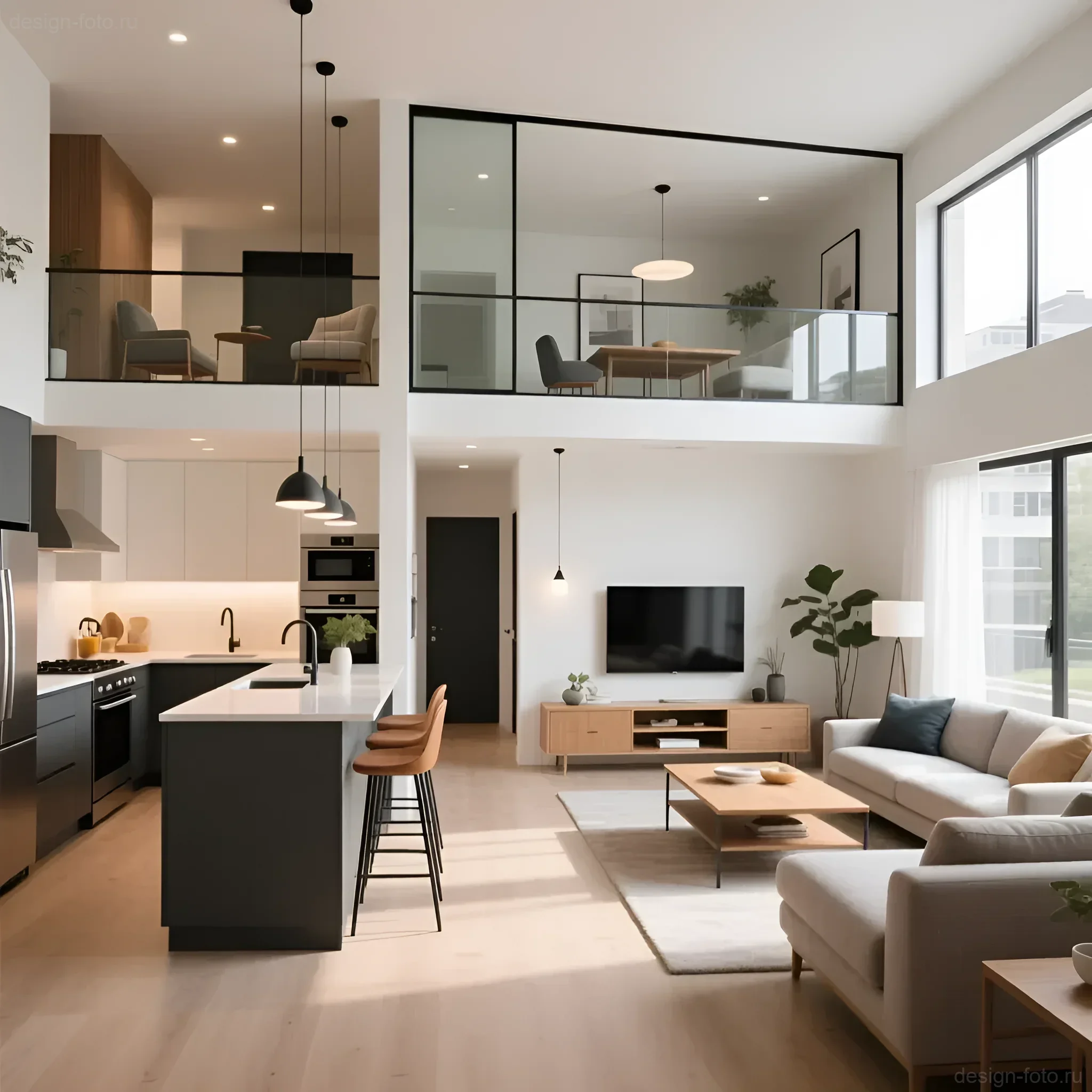
Combining a kitchen and living room is not just a fashionable trend, but a strategic planning solution aimed at improving quality of life, optimizing square footage, and enhancing social communication within the family. However, creating a unified yet functional and harmonious space requires a deep understanding of zoning principles. As practicing design architects, we emphasize: the success of the project depends on clearly dividing zones by their purpose while maintaining the visual integrity of the interior.
Functional Zoning of a Kitchen-Living Room: What It Is and Why It’s a Trend
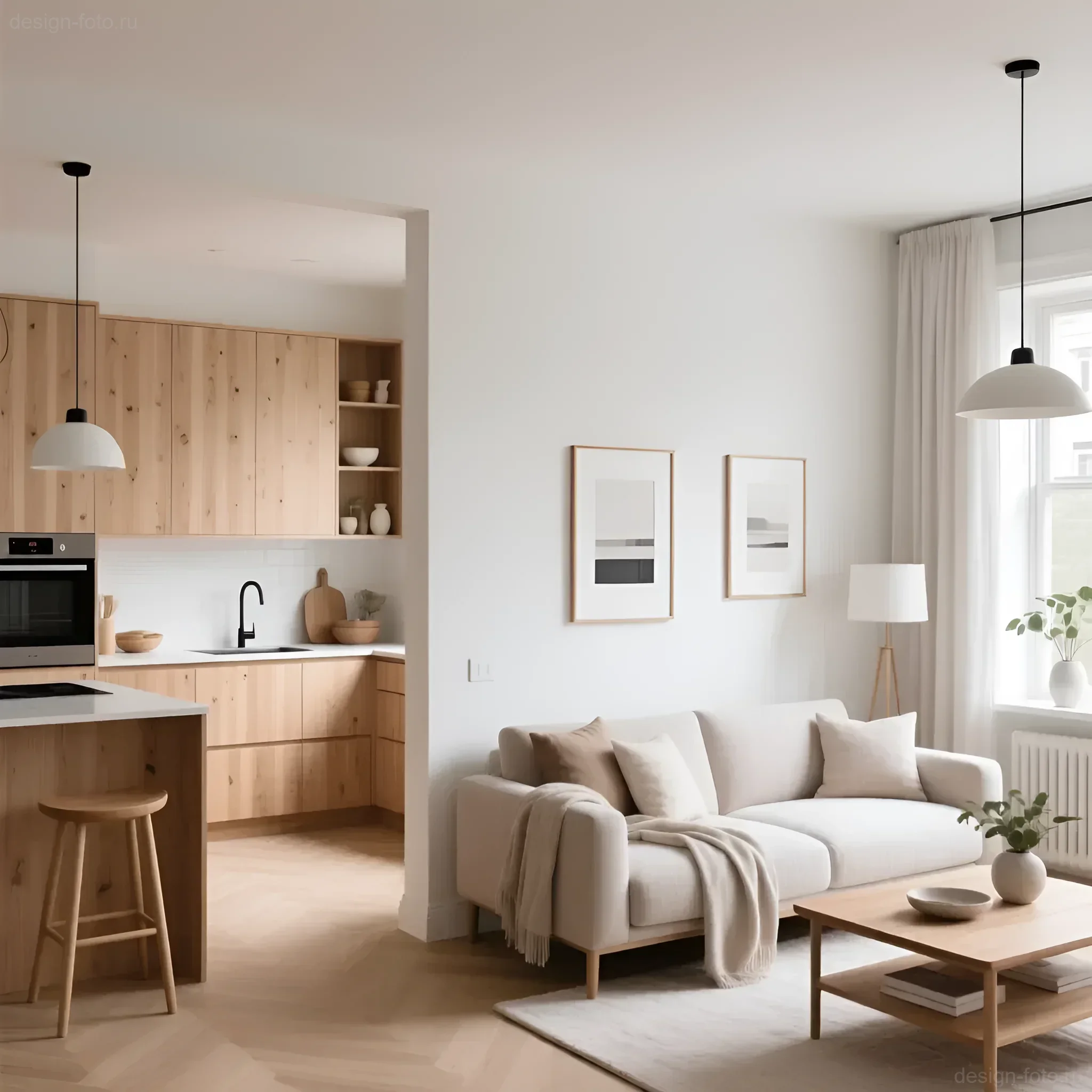
Functional zoning is the process of dividing a combined space into separate work and recreation areas, each with its clear purpose (cooking, dining, relaxing, working), while maintaining a general sense of openness. This is not physical division by walls, but rather visual and semantic structuring.
Why a Combined Space Remains a Dominant Trend:
- Ergonomics for Small Spaces: In typical apartments (especially in new buildings with European layouts), demolishing the partition between the kitchen and living room allows you to ‘gain’ up to 3–5 square meters by eliminating corridors and unused corners.
- Social Engagement: The person cooking remains included in communication with family or guests. This is critically important for modern family scenarios.
- Natural Lighting: Combining zones allows light from the living room windows to penetrate deep into the kitchen area, improving insolation and saving electricity.
The main task of zoning is to make the transition between the highly functional, ‘dirty’ zone (kitchen) and the relaxation zone (living room) as smooth and logical as possible, avoiding visual chaos.
Stylistic Approaches to Combining Kitchen and Living Room: From Loft to Scandi
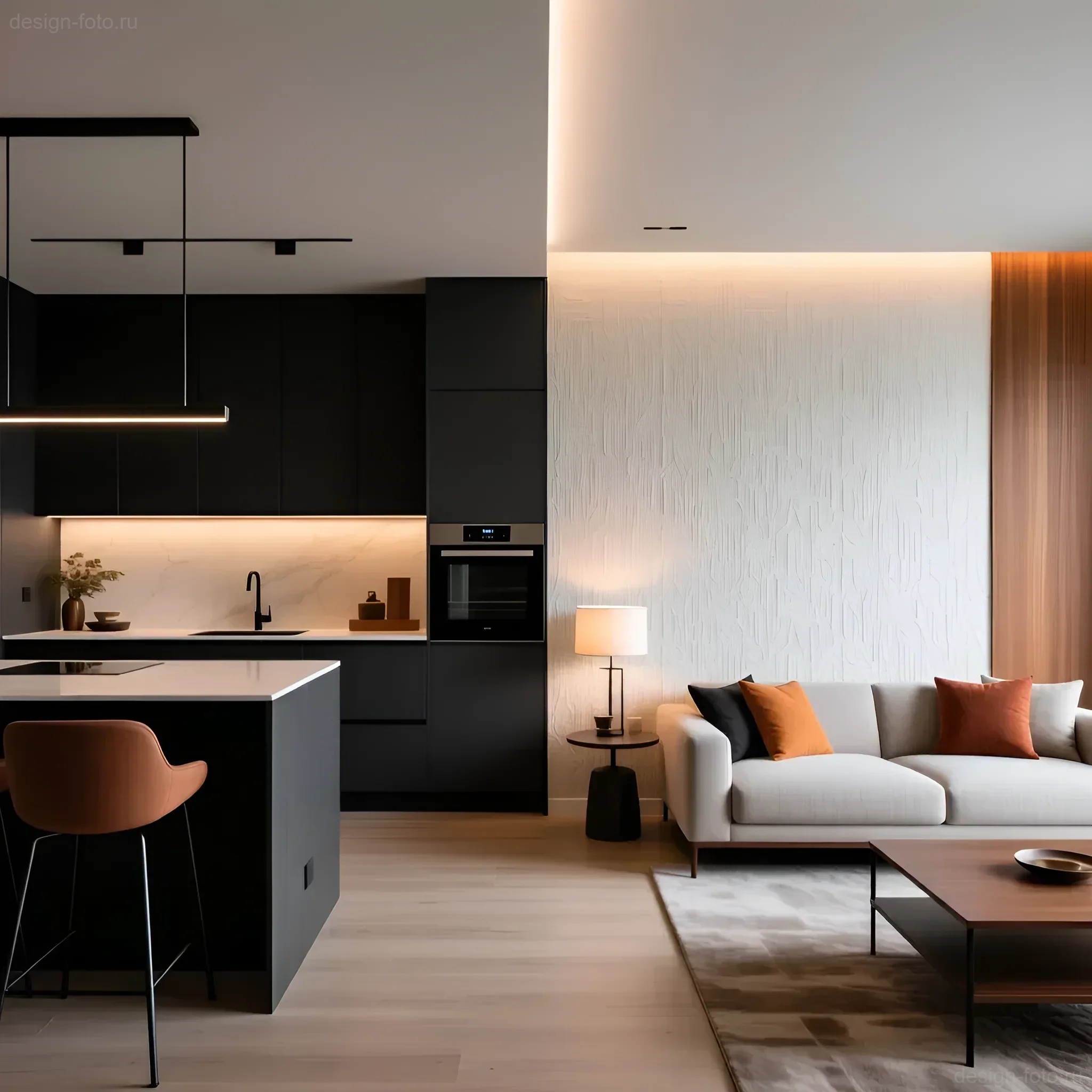
The choice of style dictates which zoning tools will be most effective. Each direction has its own ‘markers’ for functional separation.
Scandinavian Style: Minimalism in Separation
Scandi prefers soft, unobtrusive zoning. Here, the emphasis is on color palette and textures. The kitchen and living room are often decorated in a unified light (white, gray) tone. Separation occurs through:
- Flooring: In the living room – light wooden parquet or laminate; in the kitchen – tiles or porcelain stoneware imitating stone or wood, but with a contrasting pattern or a darker shade.
- Furniture: Using sideboards or open shelving units (120–150 cm high) that do not overload the space but clearly define the boundary.
Industrial Loft: Clear Physical Boundaries
Loft allows for the most radical and striking physical dividers, which themselves become art objects:
- Glass Partitions: Sliding or stationary partitions in black metal frames (‘Manhattan’ style). They let light through but can isolate smells and noise when needed, which is critically important for the kitchen area.
- Accent Wall: Using brickwork or concrete in the living room area, while kitchen backsplashes and facades remain smooth and monochrome.
Modern Minimalism: Invisible Zoning
Here, zoning is achieved through hidden systems and perfect geometry. Kitchen facades are often handleless (Push-to-Open system) and blend with the walls (e.g., gray or graphite facades reaching the ceiling), masking the work area. The boundary is often an island or peninsula kitchen made of the same material as the countertop, creating a single monolithic object.
Materials and Color Solutions for Visual Zone Separation
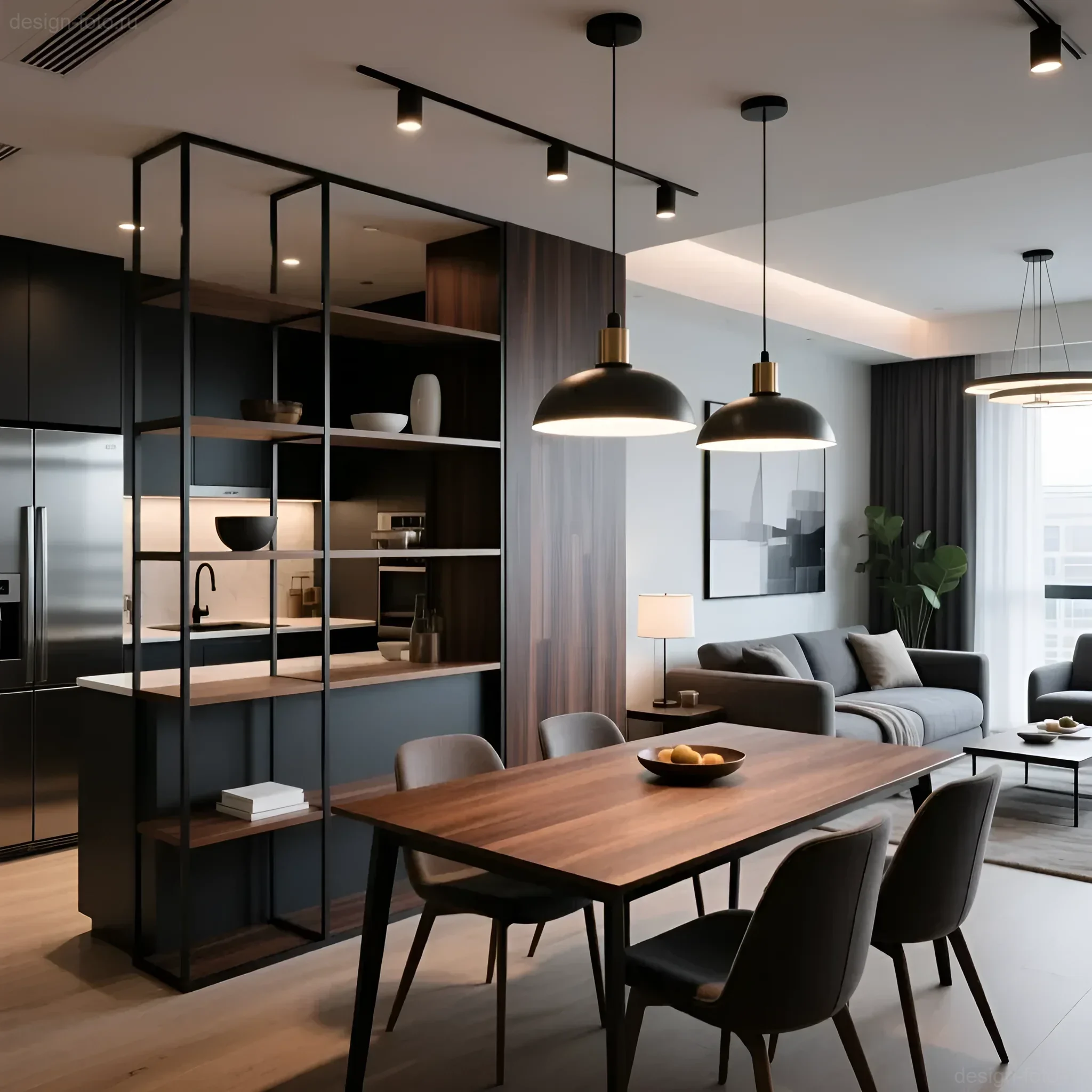
Materials are our main tool for creating a functional map of the floor and walls. The correct choice and joining of materials are not only aesthetically pleasing but also solve practical problems.
Flooring: The Main Divider
Changing the flooring is the most obvious and effective way to zone. However, the joint must be not only beautiful but also technically correct.
- Kitchen (Work Area): Requires high wear resistance, moisture, and grease resistance. Porcelain stoneware (PEI class 4 or 5) or large-format tiles are ideal. A standard tile size of 60×60 cm minimizes grout lines.
- Living Room (Relaxation Area): Requires warmth and coziness. Use engineered wood, parquet, or high-quality laminate (AC4/32 class and above).
- Joining Techniques: Avoid thresholds. Use a direct ’tile-wood’ joint with a compensation gap filled with cork sealant, or a figured joint (e.g., ‘hexagon’ or ‘wave’), which requires a highly skilled installer.
Wall Color and Texture
The color palette should be unified but with variations in saturation. For example, if the living room is dominated by a light gray tone, the kitchen area can use accent facades or a backsplash in a deeper graphite or blue shade.
Practical 60/30/10 Rule: 60% – main neutral color (walls, large surfaces), 30% – secondary color (furniture, textiles), 10% – accent color (decor, backsplash). When zoning, 60% and 30% should be as similar as possible to maintain unity, while 10% can be unique to each zone.
Optimal Layout and Zoning Methods for a Kitchen-Living Room (Partitions, Lighting, Furniture)
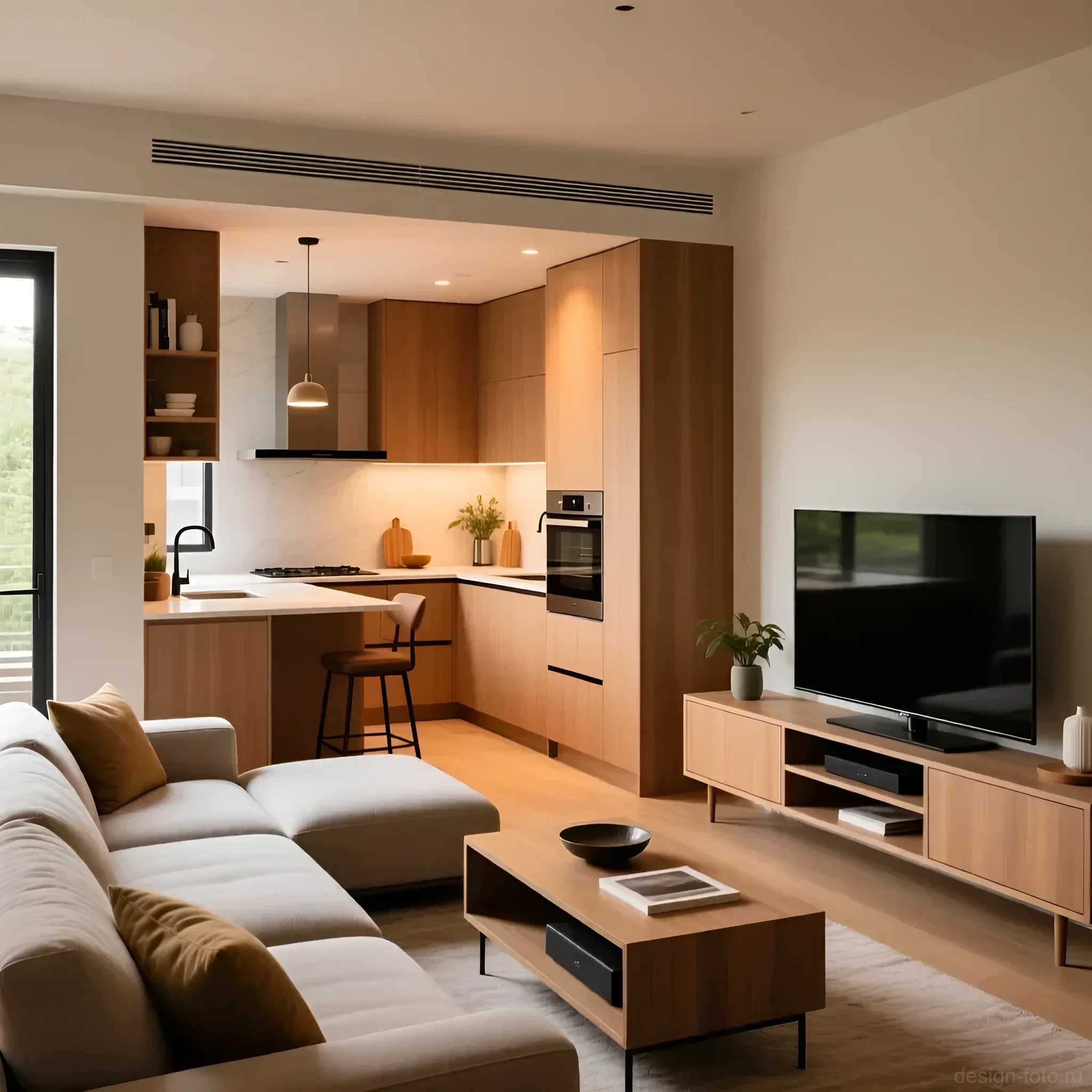
The choice of a specific zoning method depends on the room’s area, geometry, and project budget. We highlight three key tools: physical barriers, lighting scenarios, and furniture compositions.
1. Physical and Semi-Physical Barriers
- Sliding Partitions: An ideal solution for small apartments where it’s necessary to temporarily isolate smells and noise. We recommend using systems that completely retract into a wall pocket (concealed installation) or are made of frosted/textured glass to hide kitchen clutter.
- Decorative Slats (Lamellas): Wooden or metal vertical slats installed with a spacing of 5–10 cm. They allow light and air to pass through but visually limit the area. This is an excellent solution for separating the dining area from the sofa area.
- Low Partitions/Consoles: Building a low (90–110 cm) wall that serves as a base for a bar counter or console table on the living room side.
2. Lighting Scenarios
Light is the most flexible and least expensive zoning method. For a combined space, at least three independent lighting groups are needed:
- Task Lighting (Kitchen): Bright, directional light (4000–5000K temperature, neutral white). Use built-in linear LED fixtures under upper cabinets and track systems that allow you to change the beam direction.
- Dining Lighting (Dining Area): Decorative pendant lights or chandeliers positioned directly above the center of the table. Suspension height: 75–90 cm from the tabletop. Light temperature: 2700–3000K (warm, cozy).
- Ambient Lighting (Living Room): Soft, diffused light (floor lamps, sconces, hidden perimeter lighting). Use dimmers to adjust brightness depending on the scenario (watching a movie, reading).
3. Furniture Zoning
Furniture should function as an architectural element. This is the most common and functional separation method.
- Kitchen Island/Peninsula: An island is an ideal boundary. Standard height is 90–92 cm (for comfortable work). On the living room side, the island can be supplemented with open shelves for books or a wine niche.
- Sofa: A sofa placed with its back to the kitchen clearly defines the relaxation area. It’s important that the back of the sofa is aesthetically finished (e.g., upholstery or a decorative console).
- Display Shelving Units: Open, see-through shelving units (e.g., industrial-style metal ones) maintain airiness but create a barrier where you can place decor unrelated to either the kitchen or the living room.
Practical Tips on Ergonomics and Furniture Arrangement in a Combined Space
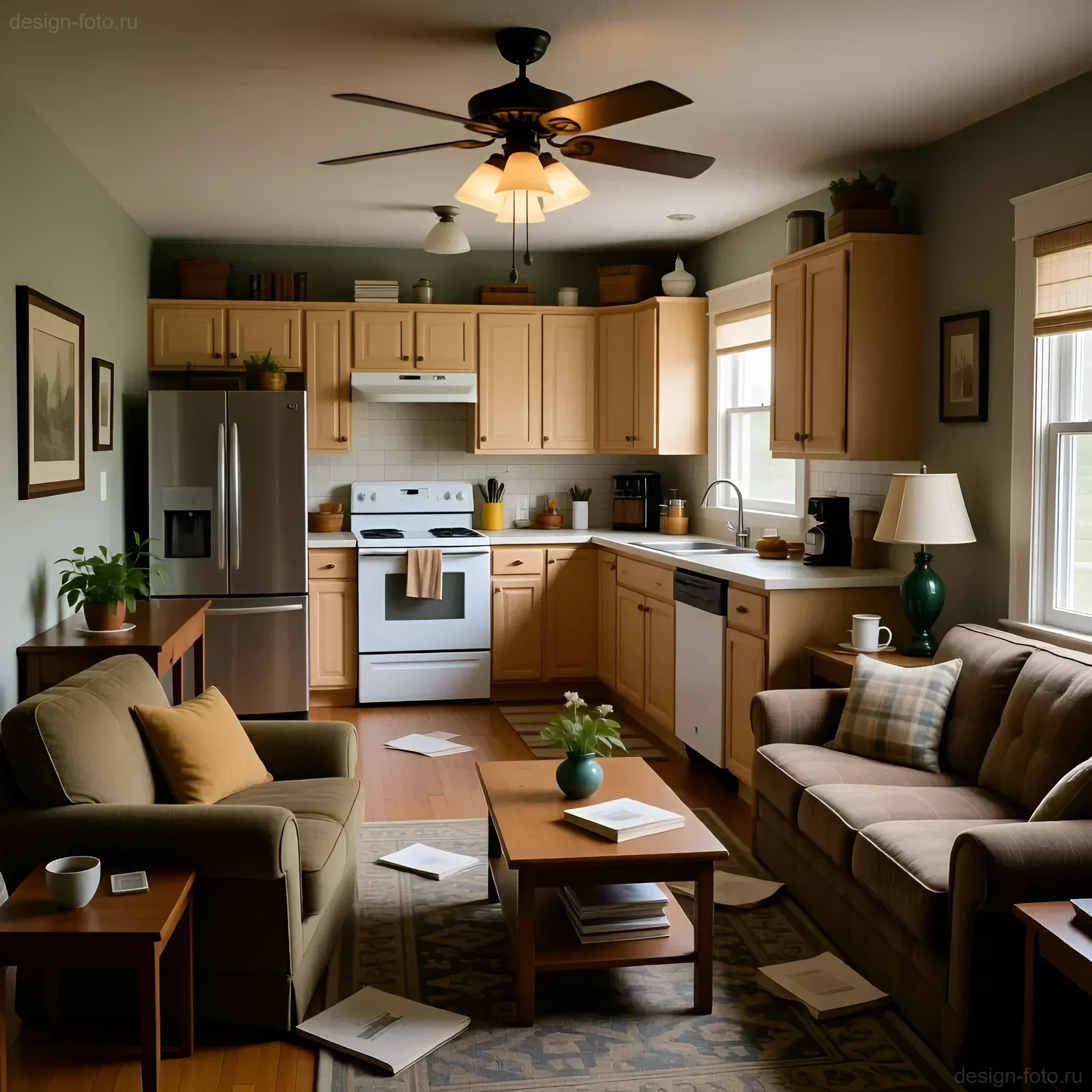
Ergonomics in a combined space requires adherence to two key principles: maintaining the work ‘triangle’ in the kitchen and ensuring comfortable passage in the living room.
Kitchen Area Ergonomics
The work triangle (storage–sink–cooking) should be as compact as possible. In a combined space, L-shaped or U-shaped layouts with an island are often used.
- Passages: The minimum distance between the island/peninsula and the main cabinetry should be 100–120 cm. This is necessary for two people to work or pass comfortably, even if a cabinet or dishwasher is open.
- Ventilation: This is not just advice, it’s a critical requirement. The range hood must be powerful (1000–1200 m³/h recommended for an area of 30–40 m²) and have a low noise level. Preference should be given to models with perimeter suction and an external motor, if possible.
- Hidden Storage: All small appliances (toaster, coffee maker) should be easily stored in tall cabinets or appliance garages so that the work area always looks tidy from the living room.
Living Room and Dining Area Ergonomics
The relaxation area should be visually separated from the work chaos.
- TV Distance: When planning the sofa arrangement, consider the optimal distance to the screen. For a 55-inch TV, this is 2.5–3 meters.
- Dining Area: The dining table often becomes a buffer between the kitchen and the living room. Ensure there is enough space around the table for comfortable chair pull-out – at least 60–70 cm from the edge of the table to the nearest wall or furniture.
- Rug Size: The rug in the living room should be large enough for the front legs of the sofa and armchairs to rest on it. This visually ‘grounds’ the relaxation area and separates it from the kitchen’s tiled floor.
Common Mistakes in Kitchen-Living Room Zoning and How to Avoid Them
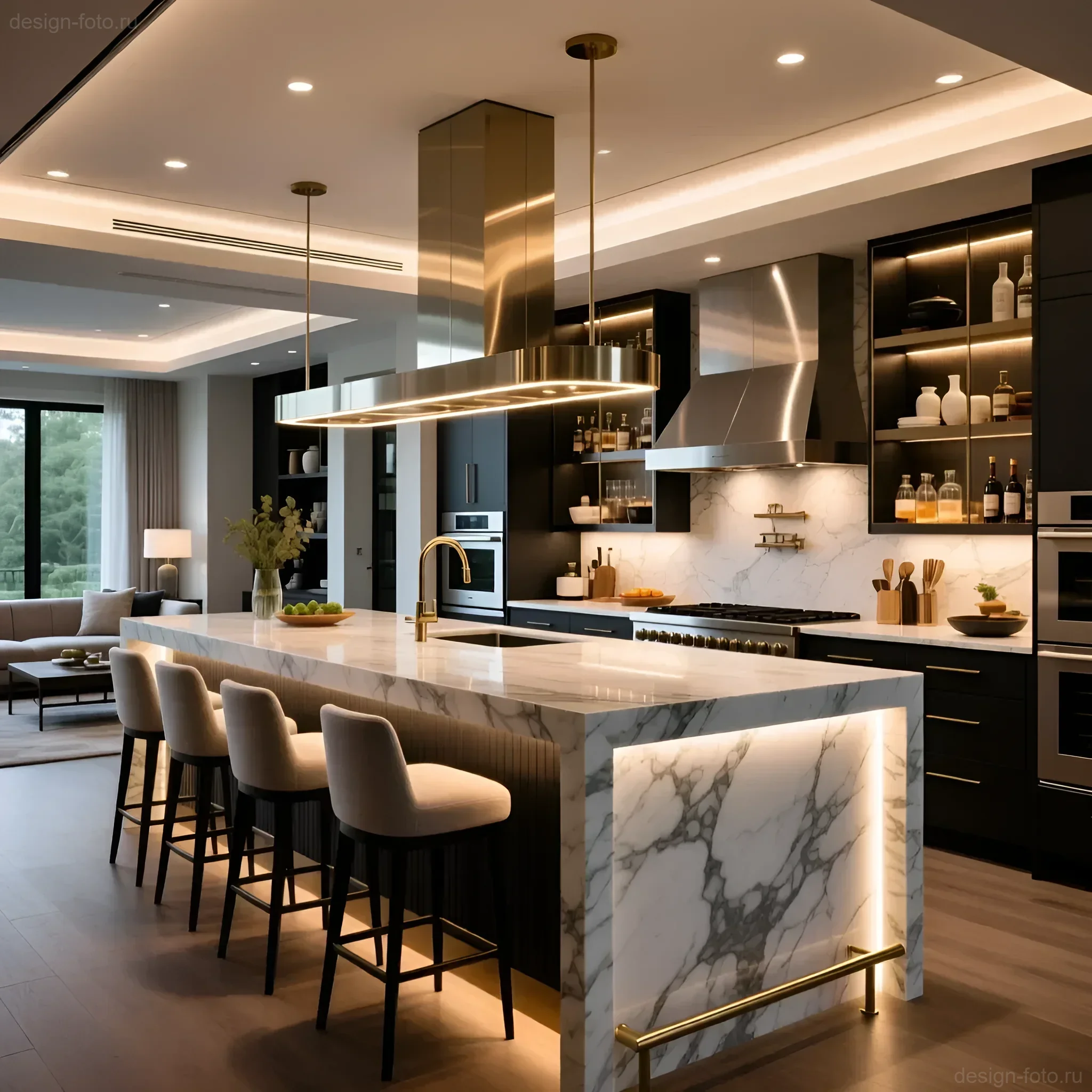
Despite its apparent simplicity, a combined space can be easily ruined if its specific use is not considered.
Mistake 1: Insufficient Range Hood Power and Poor Sound Insulation
- Problem: Cooking odors (even from the simplest dishes) permeate the living room textiles. The noise of a running dishwasher or range hood interferes with watching movies.
- Solution: Invest in high-performance, low-noise range hoods (up to 45 dB on medium power). Choose quiet appliances (refrigerators, dishwashers – noise class up to 40 dB).
Mistake 2: Lack of Harmony in Styles and Materials
- Problem: The kitchen is in high-tech style (gloss, chrome), while the living room is in Provence (florals, ruffles). The space breaks down into two conflicting rooms.
- Solution: Choose a unified base (neutral colors, same type of wall finish). Use common elements: for example, if the kitchen has matte gray MDF facades, the living room coffee table can be made of the same material.
Mistake 3: Kitchen as a Storage Room
- Problem: The kitchen work surface is constantly cluttered with small appliances, dishes, and food, which is visible from the living room.
- Solution: Maximize integrated storage. Provide deep drawers for mixers and blenders, use tall cabinets for built-in appliances. Create a ‘buffer’ zone on the island where work items can be quickly hidden before guests arrive.
Mistake 4: Incorrect Lighting
- Problem: Using a single central light source for the entire space. This makes the cooking area too dim and the relaxation area too bright and uncomfortable.
- Solution: Strictly differentiate lighting scenarios. Install separate switches and dimmers for each functional zone (work triangle, dining table, sofa group).
Best Examples of Functional Kitchen-Living Room Zoning Implementation (Photos and Cases)
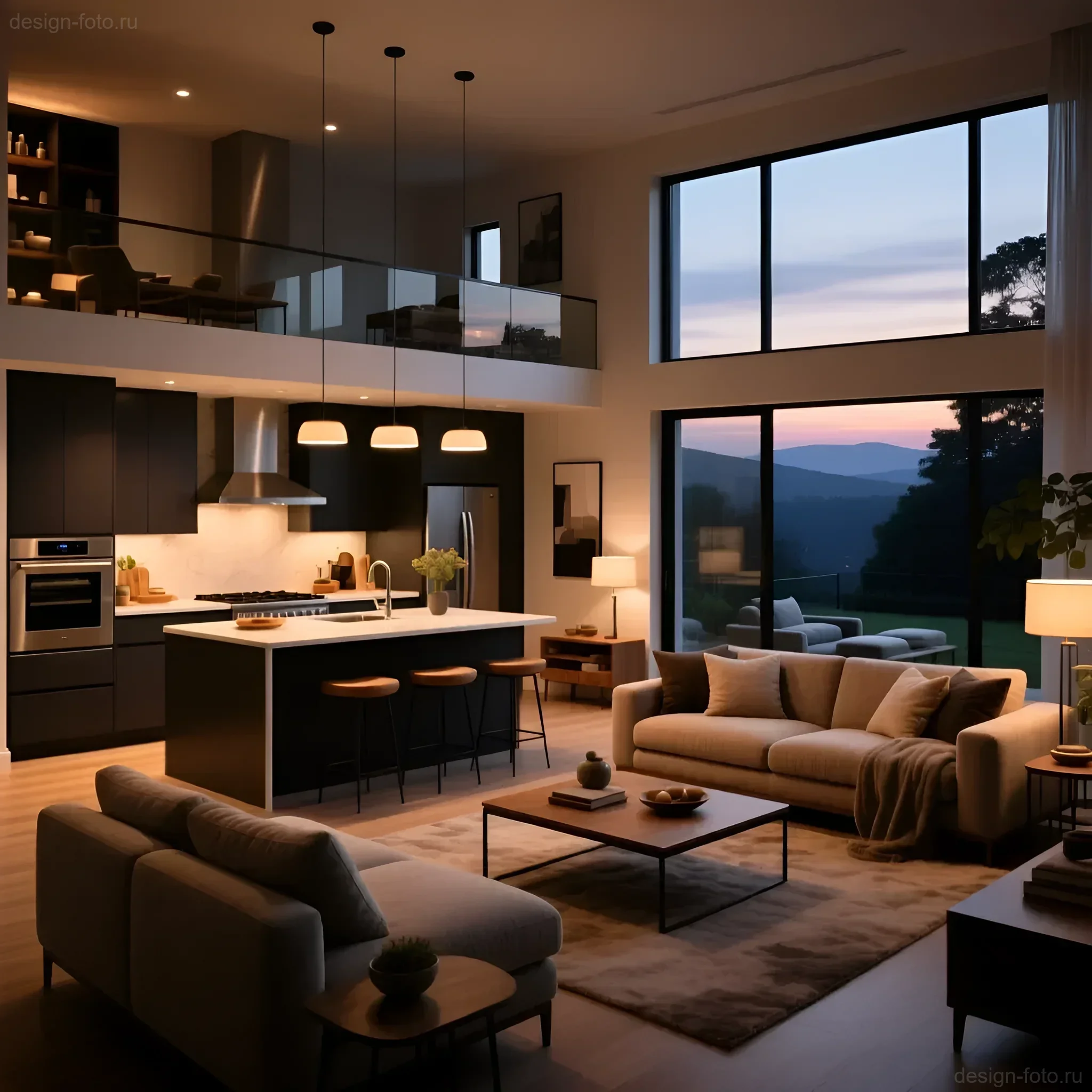
Let’s consider several effective and proven architectural solutions that we often use in projects.
Case 1: Zoning Through a Multi-Level Ceiling and Island
In apartments with high ceilings (from 2.8 m), it’s effective to use ceiling level variations. A plasterboard box (about 15–20 cm) is installed above the kitchen area, incorporating a powerful range hood, technical lighting, and a track system. This box physically and visually ‘grounds’ the work area.
- Boundary: Kitchen island with a bar counter.
- Lighting: Built-in spotlights in the box above the kitchen; a long decorative chandelier over the island.
- Materials: Porcelain stoneware above the island; parquet board behind the island.
Case 2: Using a Double-Sided Fireplace or Bio-fireplace
A double-sided fireplace, built into a low partition (140–160 cm), is a powerful focal element and a functional divider at the same time. It creates coziness and unifies views but physically separates the zones.
- Boundary: Fireplace partition (made of non-combustible materials, e.g., concrete-look porcelain stoneware).
- Function: Provides a view of the fire from both the living room and the dining area, creating a common center of attraction.
Case 3: Zoning with a Podium
In some cases (if the room height allows), the kitchen area can be raised on a podium (10–15 cm). This clearly defines the boundary and allows for hiding utilities. However, this solution requires caution as it can be hazardous if the step lighting is not adequate.
Conclusion: Creating a Harmonious Space for Life and Relaxation
Functional zoning of a kitchen-living room is a delicate balance between openness and structure. Your goal as an owner or designer is to create a space that not only looks beautiful but is also maximally convenient for daily use. Remember that a combined zone requires discipline in storage and an uncompromising approach to technical equipment (especially ventilation).
Use principles of multi-level lighting, choose contrasting yet harmonious materials for floors and walls wisely, and, most importantly, let furniture play the role of architectural dividers. Only then will you get not just a large room, but a truly functional, ergonomic, and harmonious interior that will serve you for many years.
Рекомендуем:
 Budget Zoning: How to Create Comfort in a Rented Apartment Without Renovation
 Bedroom and Workspace Zoning: Comfort, Ergonomics, and Productivity
 Mobile Zoning: Screens, Shelving, and Curtains for a Flexible Living Room
 Art Deco Colors: Black, Gold, Emerald, Burgundy – Luxury and Practical Tips for Your Interior
 How to Maintain Perfect Order in a Minimalist Interior: A Practical Guide
 Minimalism in Interior Design: The Secret to Style, Ergonomics, and the Line Between Emptiness
 Drywall Partitions for Zoning: Functionality, Installation, and Ergonomics
 Art Deco Mirrors: Geometry and Luxury That Transform Interiors
 Gypsum or Cement Plaster: What and Where to Use?
 Wall Cladding with Wood Paneling: A Step-by-Step Guide
 Bark Beetle Decorative Plaster: Application Technology
 Washable wallpaper for the kitchen: why it’s the best idea for your renovation?
 Joint filler for tiles: how to choose the color and apply it correctly
 Which Tile to Choose for a Small Bathroom: Color, Size, Texture, and Space-Expanding Secrets
Grout for tiles: how to choose the color and apply it correctly
Which Tile to Choose for a Small Bathroom: Color, Size, Texture, and Space-Expanding Secrets
Grout for tiles: how to choose the color and apply it correctly
 Interior Design and Pets: How to Combine Aesthetics and Pet Comfort
 How to Make a Brick Wall in an Interior (Imitation)
 Nautical Style in Interior Design: How to Create a Coastal Atmosphere in a City Apartment
 Internal Wall Insulation: Materials and Technology
 DIY Venetian Plaster: Is It Possible?