
In the context of the growing popularity of remote work and limited living space, the task of combining a sleeping area and a home office has become one of the most pressing in modern interior design. This is not just a matter of furniture arrangement; it is a complex architectural and psychological project that requires precise ergonomic calculations, a well-thought-out lighting scenario, and competent visual separation. Our main goal is to create a space where productivity does not interfere with complete rest, and vice versa.
Bedroom and Workspace Zoning: Secrets of Harmonious Combination
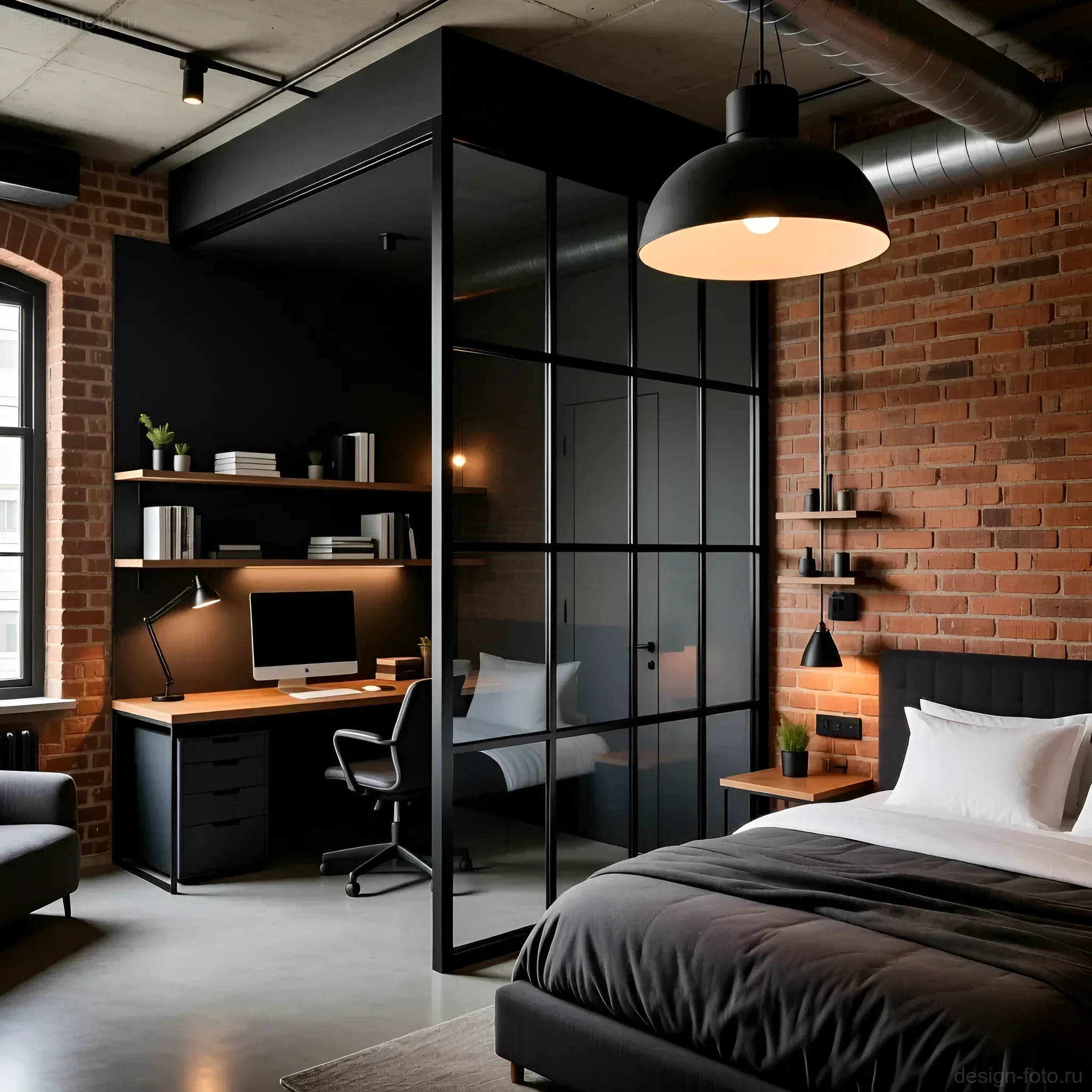
The key problem we solve when combining a bedroom and an office is the psychological conflict of functions. A bedroom is a zone of relaxation, low lighting, and soft textures. A workspace is a zone of concentration, bright light, and strict organization. Without clear physical or visual separation, the brain cannot fully switch between these modes, leading to a decrease in sleep quality and work efficiency.
The foundation of successful zoning is the principle of the “invisible border.” Even if the room’s area does not allow for a capital partition, we must create the feeling that the work area and the rest area exist in their own separate “worlds.”
- Functional Autonomy: The workspace must be fully self-sufficient (outlets, document storage, task lighting) and not require intrusion into the sleeping area.
- Acoustic Comfort: If your work involves video conferencing, it is necessary to minimize sound transmission to the sleeping area (use acoustic panels or heavy curtains).
- Visual Isolation: The desk should be positioned so that when lying in bed, you cannot see the monitor, and when working, you are not distracted by the bed.
Current Styles and Approaches to Combining Bedrooms and Offices: From Minimalism to Loft

The choice of style plays a crucial role, as some directions cope better with zoning than others. Our task is to use stylistic techniques to enhance the separation of functions, not to mix them.
Minimalism and Scandinavian Style
These styles are ideal for small spaces as they combat visual clutter. The workspace in these styles is often hidden or transformable.
- Solutions: Use built-in wardrobes where the work surface slides out or folds down. When not in use, the office completely disappears.
- Color: A unified light palette (white, light gray), but with the introduction of one contrasting, richer color in the work area (e.g., a dark blue wall or a bright organizer) to stimulate concentration.
Loft and Industrial
These styles allow for the use of physical but transparent partitions, which are excellent for visual separation without losing natural light.
- Solutions: Metal frame partitions with glass (frosted or textured). They create a clear boundary while maintaining a sense of a unified volume.
- Furniture: Strict, geometric desks made of solid wood or metal that contrast with the softness of the bed.
Modern Classic and Art Deco
In more spacious bedrooms, these styles can use library shelves or podiums for zoning. The workspace is designed as a study-library, giving it solidity and separation.
Choosing Finishing Materials and Color Schemes for Visual Zone Separation
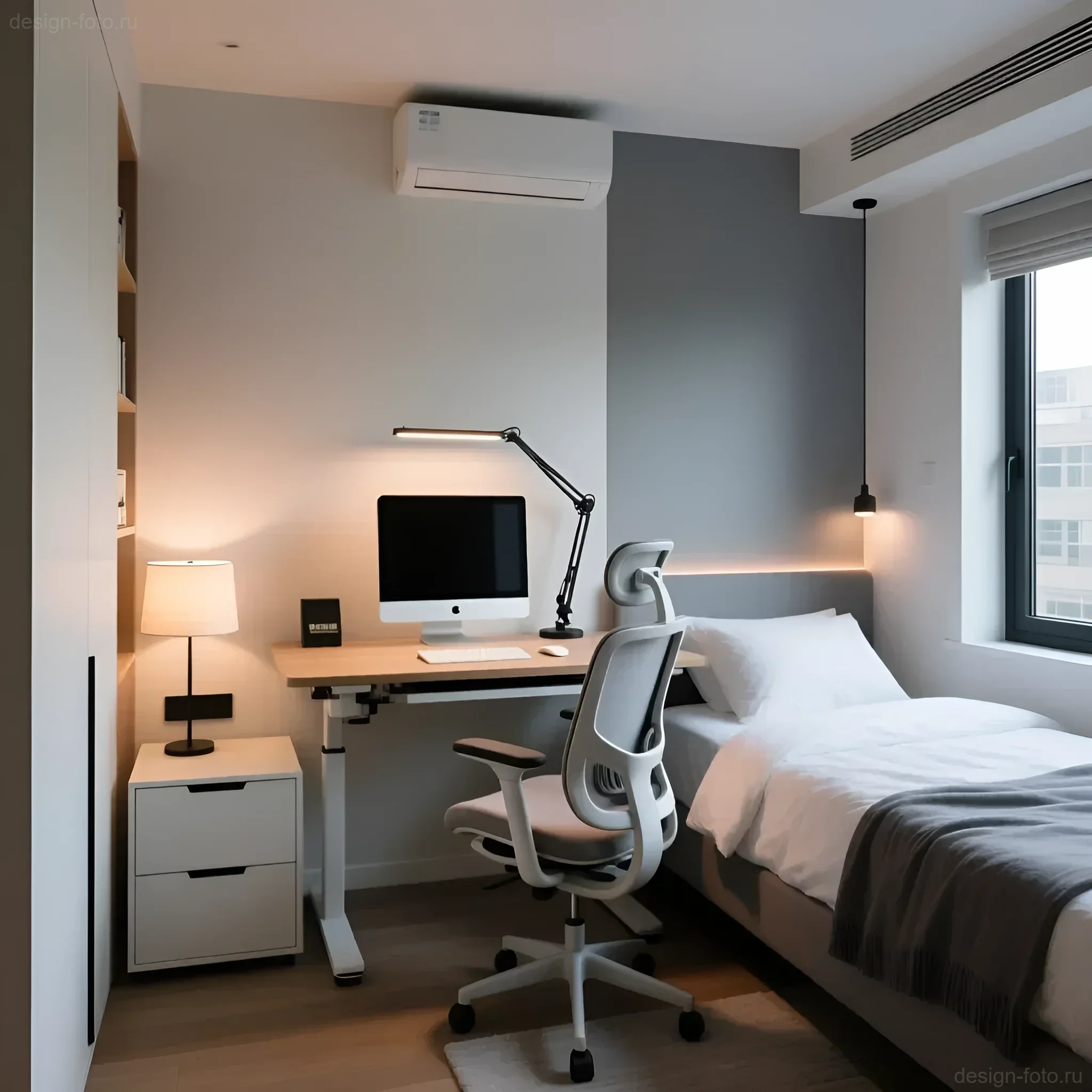
Finishing is your main tool for creating invisible boundaries. We use differences in textures and color temperature to subconsciously signal a change in the room’s function.
Color Differentiation
It is necessary to avoid sharp, loud colors in the work area that can penetrate the rest area. It is better to use subtle differences in saturation and temperature.
- Sleeping Area: Warm, muted, enveloping tones (beige, light gray, dusty pink, deep blue). Low light reflectivity.
- Work Area: More neutral and cool tones (pure white, light blue, graphite). High light reflectivity for better work illumination.
- Accent: Highlight the wall behind the desk with a contrasting but not aggressive color or texture (e.g., decorative brick or wooden slats) to visually “anchor” the work area.
Textures and Materials
Different floor coverings are the most effective, albeit most labor-intensive, method of zoning.
- Floor: In the sleeping area, soft, sound-absorbing materials are preferred (carpet, parquet flooring). In the work area, more practical and wear-resistant materials (class 33 laminate or concrete-look porcelain stoneware). It is important that the joint between the coverings is done neatly, without height differences.
- Walls: Textile wallpaper or soft wall panels are acceptable in the sleeping area. In the work area, smooth, easy-to-clean surfaces (paint, vinyl wallpaper). Consider using acoustic panels behind the monitor to reduce echo during video calls.
Layout and Ergonomics: How to Properly Organize Space for Sleep and Work
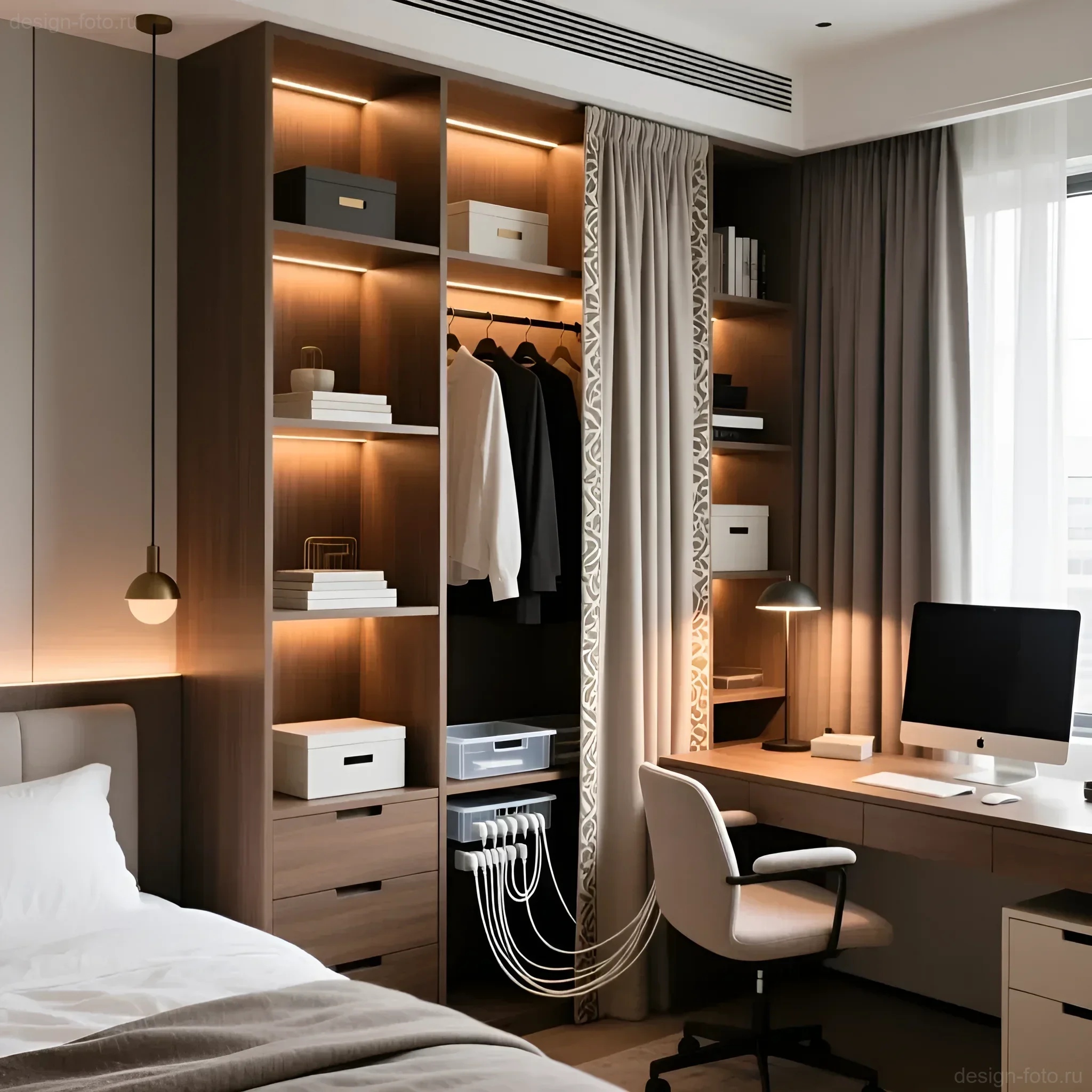
Ergonomics in a bedroom-office requires a particularly thorough approach, as every centimeter of space must work as efficiently as possible. Our task is to meet workspace standards without compromising the privacy of the rest area.
Desk Placement Relative to Window and Bed
The ideal desk placement is perpendicular to the window. This provides maximum insolation without direct glare on the monitor. If the desk is placed parallel to the window, glare is inevitable. If it’s with your back to the window, you will cast a shadow on the work surface.
Golden Rule: The bed should be as far as possible from the desk and, if possible, not in your field of vision while working. If this is not possible, use a physical or visual barrier.
Key Ergonomic Parameters of a Desk
You cannot sacrifice health for space savings. Standard workspace requirements:
- Desk Depth: Minimum 60 cm, optimally 70–80 cm. This is necessary to maintain a safe distance from the monitor (50–70 cm).
- Desk Width: Minimum 120 cm for comfortable placement of a laptop/monitor and workspace.
- Passage: Free passage around the office chair and bed should be at least 70 cm. If the passage is rarely used, 55 cm is acceptable, but it is uncomfortable.
- Storage: Use vertical storage (wall shelves above the desk or narrow cabinets) to save space.
Transformable Furniture
For rooms less than 14 sq. m, consider the following solutions:
- Transformer Desk: A desk built into a wardrobe or folding down from the wall (Murphy desk system).
- Wall Bed: In extreme cases, if the office is used more often than the bedroom, a vertically retractable bed can be considered.
Practical Zoning Tips: Functional Partitions, Light, and Furniture
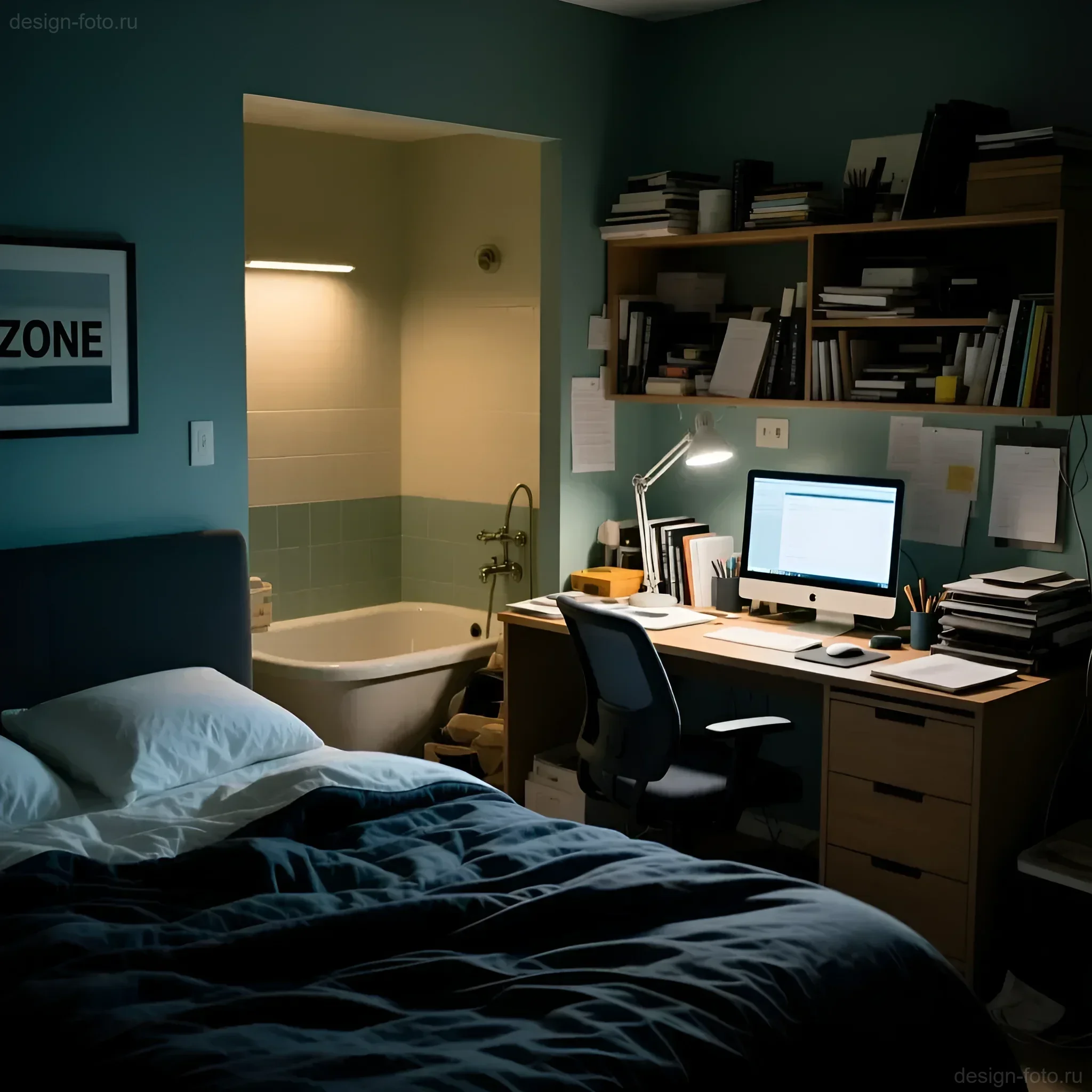
Physical separation is the most reliable method. However, it should be light, not “eat up” space, and not block light.
Types of Functional Partitions
- Shelf Dividers: This is an ideal solution. A shelf 30–40 cm wide, open on both sides, simultaneously serves as a storage system for books/documents and allows light to pass through. Important: at eye level, it is better to leave the shelf empty or fill it with decorative elements to avoid the feeling of a “wall.”
- Sliding Systems: Partitions made of frosted or tinted glass in a thin metal profile. They provide complete visual isolation when necessary (e.g., during sleep) and can be fully retracted during the day.
- Decorative Slats (Lamellae): Vertical wooden or MDF slats. They create a strong visual barrier while maintaining the airiness of the interior and allowing light to pass through. The spacing between slats is usually 10–15 cm.
- Heavy Curtains or Screens: The most budget-friendly and mobile solution. Choose heavy, multi-layered fabrics that also have sound-absorbing properties.
Lighting Scenario as a Zoning Tool
Light must be clearly differentiated.
- Task Lighting: High color rendering index (CRI > 90) and cool color temperature (4000K–5500K). A local desk lamp, adjustable in height and direction, is mandatory. General lighting in this zone can be bright and spot-like.
- Sleep Lighting: Warm light (2700K–3000K). Use sconces, bedside lamps, or hidden LED lighting. General ceiling light should be soft and diffused, often with dimming capabilities.
- Contour Zoning: LED strips can be used, embedded in baseboards or furniture, to visually outline the boundaries of the work area.
Common Mistakes in Organizing a Workspace in a Bedroom and How to Avoid Them
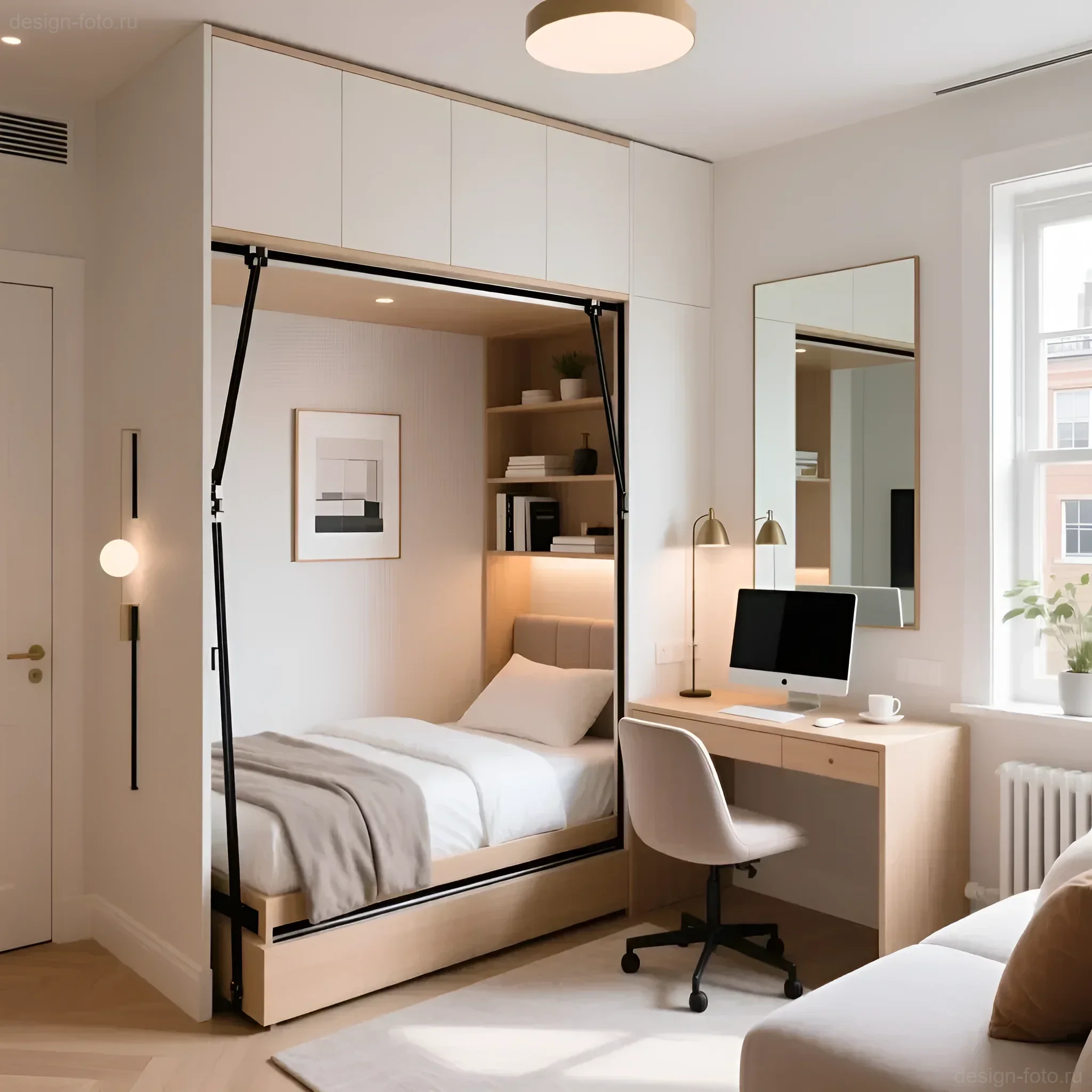
Even with an ideal plan, mistakes are often made that negate all efforts in zoning and ergonomics. As professionals, we must anticipate them.
Mistake 1: Ignoring Sound Insulation
Problem: Noise from work (keyboard, calls) disturbs a sleeping partner, or conversely, sounds from the bedroom interfere with concentration. If you work at night, this problem is critical.
Solution: Use heavy, multi-layered curtains (blackout) and acoustic panels on the wall adjacent to the work area. If possible, place the desk further away from the shared wall with neighbors.
Mistake 2: Insufficient or Incorrect Lighting
Problem: Using a single light source (ceiling) for the entire room. This leads to either a too dim workspace or too bright light in the rest area.
Solution: Create independent lighting scenarios. The desk requires directed, cool light. The rest of the room needs soft, warm light. Never place the monitor so that there is a bright light source behind it (window or lamp).
Mistake 3: Visual Clutter and Disorder
Problem: Work documents, wires, and equipment are chaotically arranged, creating the impression of a permanent office in the bedroom.
Solution: Maximize integrated storage. All work supplies should have their place and be easily put away. Use cable management systems to hide wires. Ideally, work equipment should be hidden behind cabinet or wardrobe doors when not in use.
Mistake 4: Placing the Desk in a Corner Without Enough Space
Problem: The desk is squeezed into a narrow corner, restricting movement and creating discomfort during prolonged work.
Solution: Ensure the chair can roll back freely and there is enough space for your elbows. If the area is critically small, consider corner desks with rounded tabletops that are visually less bulky.
Case Studies and Examples of Successful Bedroom-Office Zoning in Different Square Footage
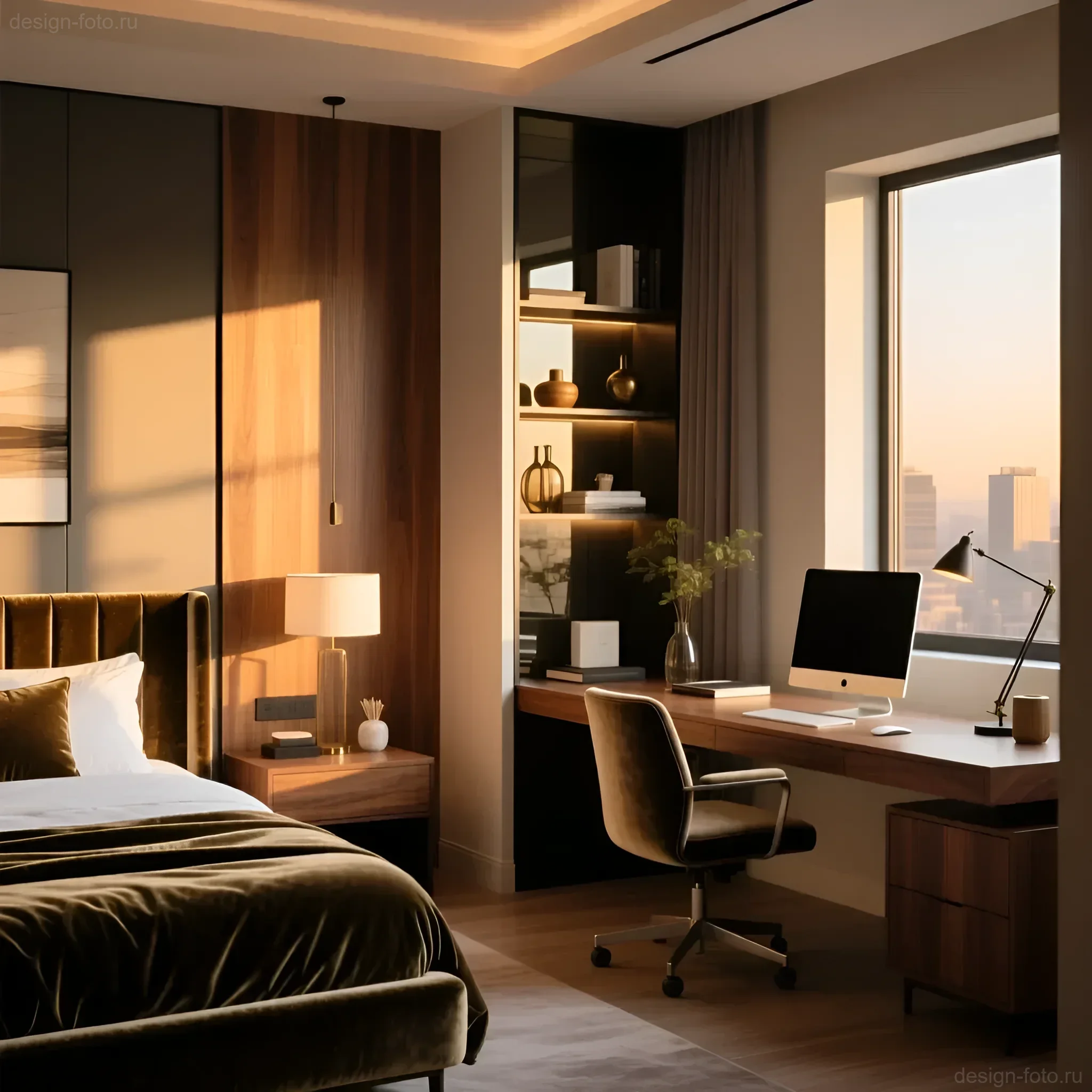
Case 1: Small Studio Apartment (12–15 sq. m)
In this case, physical zoning is impossible, so we use visual and transformable methods.
- Method: Built-in furniture. The desk is a fold-down surface integrated into the wardrobe system.
- Zoning: The bed is located in a niche or separated by a dense blackout curtain running from a ceiling cornice.
- Floor: Use a large, cozy rug under the bed to immediately define the rest area. The work area remains on the open floor.
Case 2: Medium-Sized Room (18–22 sq. m)
Partial physical separation can be applied here.
- Method: Shelf divider. A through-shelf (35 cm deep) reaching the ceiling is installed perpendicular to the wall. It separates the headboard from the desk.
- Placement: The desk is placed near the window, and the shelf acts as a side wall, protecting the bed from work noise and light.
- Lighting: Built-in track lighting: two groups – one for the sleeping area (warm light), the second for the work area (cool light).
Case 3: Spacious Room (25+ sq. m)
Possibility of full architectural zoning.
- Method: Sliding glass partition in a “Loft” profile. This allows for complete isolation of the office when necessary and merging of the space for a sense of volume.
- Podium: The work area can be raised on a podium 15–20 cm high. This not only visually separates it but also allows for additional storage under the floor.
- Finishing: Use contrasting materials: soft panels and textiles in the bedroom, veneer or stone-look laminate in the office.
Conclusion: Creating the Ideal Space for Rest and Productivity
Successful bedroom and workspace zoning is always a balance between aesthetics and strict functionality. You, as the owner of this space, must clearly define priorities: if work takes up most of your time, the office should be dominant and as ergonomic as possible. If the room primarily remains a bedroom, the work area should be as hidden and unobtrusive as possible.
Remember that investing in quality partitions, thoughtful storage systems, and, most importantly, proper lighting will pay off handsomely. They directly affect your health, sleep quality, and, ultimately, your productivity. Do not be afraid to use contrasts in color and texture, but always maintain clean lines and order to avoid a cluttered feel. Create two independent ecosystems in one room, and you will get an ideal hybrid interior that meets all the demands of the modern pace of life.
Frequently Asked Questions (FAQ)
1. What is the minimum room size required for comfortable combination?
The optimal minimum for placing a bed (140 cm) and a full-sized desk (120 cm) with consideration for passages is about 16–18 sq. m. In rooms of 12–14 sq. m, transformable furniture and maximum vertical storage must be used.
2. Can mirrors be used for zoning?
Mirrors can visually expand space, but they are not a zoning tool. Moreover, mirrors reflecting the work area can create additional visual noise. If you use mirrors, ensure they do not reflect the monitor or the bed when you are working.
3. What is the best way to hide computer wires in a bedroom?
Use built-in cable channels in the tabletop, special boxes attached to the underside of the desk, and baseboards with internal space. Ideally, outlets should be located directly under the desk to minimize the visible length of wires.
4. What role do ceiling heights play in zoning?
High ceilings (from 2.8 m) allow for more massive physical partitions, as well as multi-level lighting and even podiums. With low ceilings (up to 2.5 m), light, transparent structures (slats, glass) should be preferred, and bulky wardrobes should be avoided to prevent a feeling of oppression.
Рекомендуем:
 Budget Zoning: How to Create Comfort in a Rented Apartment Without Renovation
 Mobile Zoning: Screens, Shelving, and Curtains for a Flexible Living Room
 Functional Zoning of a Kitchen-Living Room: A Practical Guide from an Architect
 How to Make a Brick Wall in an Interior (Imitation)
 How to Maintain Perfect Order in a Minimalist Interior: A Practical Guide
 Drywall Partitions for Zoning: Functionality, Installation, and Ergonomics
 Art Deco Colors: Black, Gold, Emerald, Burgundy – Luxury and Practical Tips for Your Interior
 Minimalism in Interior Design: The Secret to Style, Ergonomics, and the Line Between Emptiness
 Bark Beetle Decorative Plaster: Application Technology
 Which Tile to Choose for a Small Bathroom: Color, Size, Texture, and Space-Expanding Secrets
 Wall Cladding with Wood Paneling: A Step-by-Step Guide
 Washable wallpaper for the kitchen: why it’s the best idea for your renovation?
 DIY Decorative Stone Wall Installation: Your Guide to Home Transformation
 Art Deco Mirrors: Geometry and Luxury That Transform Interiors
 DIY Venetian Plaster: Is It Possible?
 How to Wallpaper Behind a Radiator
 Interior Design and Pets: How to Combine Aesthetics and Pet Comfort
 Sanding Walls After Puttying: A Perfect Surface with Your Own Hands
 Wall Putty for Wallpaper: How Many Coats Are Needed and How to Apply?
 Grout for tiles: how to choose the color and apply it correctly